EPA Ends Reactivation Policy Unless Major Modification
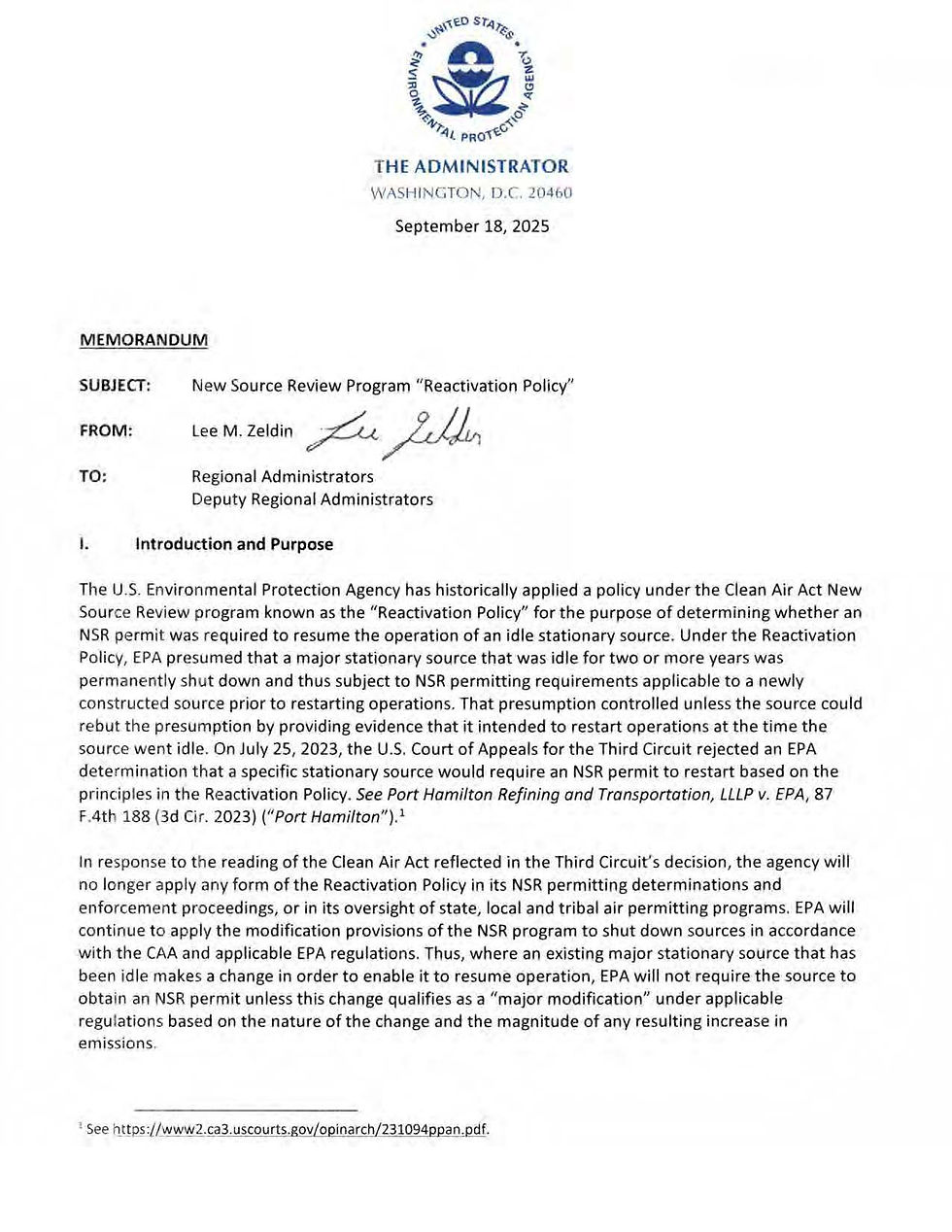
On September 18, 2025, Administrator Lee Zeldin issued a policy memorandum entitled “New Source Review Program ‘Reactivation Policy.’” In the policy, Mr. Zeldin confirmed that the EPA would follow the Third Circuit’s decision in Port Hamilton Refining & Transp. v. U.S. EPA, will apply that decision nationwide, will not apply the “major modification” aspect of the policy to a facility that only restarts, but will apply to restarts that involve a physical change or change in the method of operation beyond a mere restart, if the major modification test is triggered. EPA also signaled that while states and local authorities can be more stringent, such interpretations should be supported by independent local law and that the EPA reserve the right to review, on a case-by-case basis, state implementation plans adopting the Reactivation Policy unsupported by such local law.
ANALYSIS
The September 18, 2025, memorandum begins with a recitation of the purpose of the New Source Review (NSR) programs. It then explains that for many years the EPA had applied a “Reactivation Policy” to require sources that were permanently shut down to obtain a PSD or NNSR permit upon restart, using a presumption of permanent shut down if an emissions unit was shut down for more than two years or removed from the state’s emission inventory. The presumption, however, was rebuttable if the source showed an intent to reopen as evidenced by owner’s intent, maintenance, maintaining permits, time required to restart, and similar steps. The most complete statement of the Reactivation Policy was found in In the Matter of Monroe Electric Generating Plant Entergy Louisiana, Title V Petition No. 6-99-2 (June 11, 1999). The September 18, 2025, memorandum noted that EPA itself had expressed some doubts about the Reactivation Policy; that it had been discontinued by former Administrator Wheeler in a permitting decision; reinstated by Administrator Regan. During that reinstatement, the EPA wrote a letter to a refinery in St. Croix, U.S. Virgin Islands, stating that it must obtain a PSD permit for a proposed restart.
The owner of the St. Croix refinery challenged the EPA’s decision in the Third Circuit. The Third Circuit ultimately upheld the challenge, ruling that “The CAA limits the PSD program’s reach to only two circumstances: construction and modification …. The EPA’s Reactivation Policy extends the PSD program beyond those limited circumstances.” A contemporaneous evaluation of this decision is found in NSR Law Blog’s Reactivation Deactivated post. In the September 18, 2025, memorandum, the EPA stated:
The EPA agrees with [the Third Circuit’s] conclusion insofar as [the EPA’s] prior Reactivation Policy calls for treating as “construction” the resumption of operations at an existing major stationary source that was considered to have been permanently shutdown.
It is not permissible … to require existing stationary sources to obtain a permit based solely on resuming operation … after a period of inactivity.
EPA will no longer apply the Reactivation Policy to classify resuming operations … as construction … on a national basis.
EPA … will not consider the restarting of an emissions unit that was idled to by itself constitute a “change in the method of operation” that would potentially trigger NSR permitting requirements.
EPA reasoned that PSD does not apply to operation but only to construction or modification, which does not include operation under the prior decision in Homer City.
The EPA cautioned that it “will continue to implement and enforce the NSR applicability provisions for modifications” and that “a restart of an idled facility involving a physical change (or a change in the method of operation at the source other than simply restarting) will still require a PSD permit if it qualifies as a ‘major modification’ by virtue of the nature of the change and the degree to which it results in an increase in regulated NSR pollutant emissions.” Finally, EPA noted that states and locals could be more stringent by applicable laws in their jurisdictions that are more stringent than the Clean Air Act and that the EPA may review, on a case-by-case basis, more stringent state implementation plans that don’t have an independent state law basis.
COMMENTARY
The September 18, 2025, memorandum makes two important contributions to our understanding of the future application of the “Reactivation Policy.” First, it confirms that the EPA will abide nationwide by the Third Circuit’s determination that “construction” does not include “operation” and hence does not include restart of an existing source. This is important because the EPA has suggested in the past that it may not acquiesce in adverse court of appeals cases outside of the circuit deciding the matter. Second, the September 18, 2025, memorandum makes the clearest statement yet that restart alone is not a “change in the method of operation,” unless it is accompanied by a physical change or other change in the method of operation that would satisfy the “major modification” test. This is important because it walks back statements in the Monroe Energy order that restart alone could trigger PSD or NNSR if the emissions increase resulting from the restart exceeds the significant emission rates. The EPA’s clarification on this point is consistent with existing exemptions in the regulations and removes an area of lingering uncertainty. NSR Law Blog commends the EPA for improving certainty in the NSR programs by eliminating the difficult to apply and subjective “Reactivation Policy” in favor of the major modification test.
Comments